
Development of My Worldview
Updated: Aug 28, 2023
I begin with the self, the totality of a person, consisting of all characteristic attributes, conscious and unconscious, mental and physical. The sensing, thinking, knowing, acting self exists in the milieu of a world (more accurately, a universe) of matter, energy, information and other sensing, thinking, knowing, acting selves. The concept of self has been debated for millennia. Medical science tells us that the “self” resides within specific regions of the brain.
Our self is intrinsic to the body being embodied in the brain. Furthermore, since it is based on self-reference as the attribution of personal relevance to environment (and bodily stimuli), our self is intrinsically linked to the environment thus being embedded, physically, and an attribution of personal relevance. Our self is intrinsically social, described as the social self, which describes the linkage and integration of the self into the social context of other selves.
Our self may be described as structure and organization not just entity be it mental or physical. Such structure and organization needs to develop through childhood and adolescence with persistent changes even throughout adulthood. Despite all the changes there is persistence and continuity across time which then accounts for what can be described as identity. “Brain and self – a neurophilosophical account (https://www.ncbi.nlm.nih.gov/pmc/articles/PMC3734106/)” The self is structure and organization and at the same time a cognitive entity. The self is a dynamical entity that emerges from reciprocal brain relationships with the body and social environment.
Worldview is a by-product of the way in which a person is socialized to perceive, think, feel, experience the world and make sense of life experiences. It attempts to make sense of life experiences that might otherwise be construed as chaotic, random, and meaningless.
Self-Authorship
My worldview begins with self-authorship (variously described in personality and educational psychology literature as integrative life stories, self-defining life narratives, self-narrative, and integrated life narrative). Self-authorship, as originally coined by Kegan (1982), the term self-authoring refers to a stage of self-evolution which is reached when an individual has progressed from relying on external others (e.g., teachers, peers, parents, and authorities) to taking responsibility for one’s own meaning making (the process of how people construe, understand, or make sense of life events, relationships, and the self). Baxter Magolda (2001) advanced Kegan’s concept of self-authorship and found that although individuals use various ways to deal with developmental challenges, there were three common phases through which young adults (aged between 18-45 years) progress toward and into self-authorship.

Research into self-authorship has identified that a disequilibrating situation and the subsequent cognitive dissonance acts as the primary catalyst for the Crossroads stage of self-authorship development.
The Elements of Self-Authorship
(This discussion is condensed from Marcia Magolda’s “Self-Authorship: The Foundation for Twenty-First Century Education. New Directions for Teaching and Learning. (https://www.researchgate.net/publication/229620085_Self-Authorship_The_Foundation_for_Twenty-First_Century_Education)”
Within the self, three dimensions of development—cognitive, intrapersonal, and interpersonal—intertwine to form self-authorship which develops the foundations of cognitive maturity, integrated identity and mature relationships within the self. The intertwining of these foundations forms effective citizenship.

The intrapersonal dimension is the socialization of the self to perceive, think, feel, experience the world and make sense of life experiences.
o An integrated identity is characterized by understanding one’s own history, confidence, the capacity for autonomy and connection, and integrity.
The interpersonal dimension represents how important or dependent a person is on various relationships with others.
o Mature relationships are characterized by respect for both one’s own and others’ particular identities and cultures and by productive collaboration to integrate multiple perspectives.
The cognitive dimension enables the self to sense, think, know and act in the world/universe.
o Cognitive maturity is characterized by intellectual power, reflective judgment, mature decision making, and problem solving in the context of multiplicity.
Cognitive Dimension
The term “cognitive” conveys a broad set of mental activities (e.g., inductive and deductive reasoning, self-monitoring, knowledge retention), whereas the meaning-making characteristics described in the cognitive dimension are primarily related to one facet of cognition, developing epistemologies. Epistemic cognition reflects the structure of mental organization that underlies changes in meaning-making in the realm of knowing, most particularly, assumptions about knowledge (e.g., what can be known, how one comes to know). Personal epistemology focuses on what individuals believe about how knowing occurs, what counts as knowledge and where it resides, and how knowledge is constructed and evaluated. (https://www.taylorfrancis.com/chapters/edit/10.4324/9781003444213-13/role-cognitive-dimension-self-authorship-patricia-king)
Intrapersonal Dimension - Identity
The intrapersonal dimension is based on our identity, which is our sense of self as defined by a set of psychological characteristics that is not wholly shared with any other person. Personality is our enduring psychological configuration of characteristics and behavior that comprise an individual's unique adjustment to life, including traits, interests, drives, needs, values, self-esteem and self-concept, and emotional patterns.
Interpersonal Dimension - Relationships
The interpersonal dimension represents how important or dependent a person is on various relationships with others. A self who is defined by the relationships they are in, makes judgments based on whetherot they will fit in. Someone who is developed in the interpersonal domain has authentic and diverse relationships but is not persuaded to act based on what others think about them.
Self-Authorship Integrates the Dimensions of Self
Multiple disciplines within psychology study the dimensions of self. In this article I combine elements of personality psychology, cognitive psychology, developmental psychology, educational psychology and social psychology. I utilize the concept of self-authorship, or the internal capacity to define one’s beliefs, identity, and relations with others to define the integrated self as outlined in
Learning Partnerships, Theory and Models of Practice to Educate for Self-Authorship (https://play.google.com/books/reader?id=UA7JEAAAQBAJ&pg=GBS.PA1989&hl=en).
Self-authorship is the belief that you can rely on your own internal values to make decisions. It’s accepting the fact that you cannot control all the external events happening to you and around you, but you can control the way you react. Figure 2 highlights the developmental foundations for cognitive maturity (Epistemological), integrated identity (Intrapersonal), and mature relationships (Interpersonal). These three intertwine in the development of Self-Authorship.

Identity – Intrapersonal Foundation
Identity forms your intrapersonal foundation. How people view themselves and construct their identities is the intrapersonal dimension of self-authorship. Building an identity requires the ability to reflect on, explore, and choose enduring values. My identity is based on the following principles adapted from works of Dan McAdams and Jennifer Lilgendahl (né Pals) (https://scholar.google.com/citations?view_op=view_citation&hl=en&user=8szW6zMAAAAJ&citation_for_view=8szW6zMAAAAJ:vV6vV6tmYwMC).
1. Human lives are individual variations on a general evolutionary design.
Humans evolved developing adaptations to address a wide range of specific challenges faced by roaming hunters and foragers living together in small groups.
2. Variations on a small set of broad dispositional traits implicated in social life constitute the most stable and recognizable aspect of individuality.
Dispositional traits are those broad, nonconditional, decontextualized, generally linear and bipolar, and implicitly comparative dimensions of human individuality that go by such names as extraversion, dominance, friendliness, dutifulness, depressiveness, the tendency to feel vulnerable, and so on.
3. Beyond dispositional traits, human lives vary with respect to a wide range of motivational, social– cognitive, and developmental adaptations, contextualized in time, place, and/or social role identified as characteristic adaptations.
Characteristic adaptations include motives, goals, plans, strivings, strategies, values, virtues, schemas, self-images, mental representations of significant others, developmental tasks, and many other aspects of human individuality that speak to motivational, social– cognitive, and developmental concerns.
4. Beyond dispositional traits and characteristic adaptations, human lives vary with respect to the integrative life stories, or personal narratives, that individuals self-author to make meaning and identity in the modern world.
The self-authorship approach suggests that human beings construe their own lives as ongoing stories and that these life stories help to shape behavior, establish identity, and integrate individuals into modern social life.
5. Culture provides each person with an extensive menu of stories about how to live, and each person chooses from the menu. Because different people within a given culture have different experiences and opportunities, no two people get exactly the same menu. Furthermore, a person cannot eat everything on the menu, so narrative choices spell out a person’s relationship to culture.
If human evolution is the ultimate, distal context for human individuality (Principle 1), then culture, society, and the environmental arrangements of everyday life make up the more immediate, proximal contexts within which individual lives find their characteristic designs.
Each self has a personality that is an individual’s unique variation on the general evolutionary design for human nature, expressed as a developing pattern of dispositional traits, characteristic adaptations, and integrative life stories complexly and differentially situated in culture.
The identity foundation requires the ability to reflect on, explore, and choose enduring values. It requires coordinating various characteristics to form a coherent identity that gains stability over time yet is open to growth. To be coherent and enduring, this identity must be internally constructed rather than adopted to seek external approval. Understanding one’s particular history, confidence, the capacity for autonomy and connection, and integrity all depend on these intrapersonal capacities. These intrapersonal developmental capacities are central to achieving an intrapersonal foundation as well as necessary for attaining maturity in the other areas. For example, constructing an internal belief system and using it in decision making (i.e., cognitive maturity) requires an internal identity that is not overly dependent on the views of others. Similarly, choosing one’s values and identity characteristics (i.e., mature identity) requires contextual knowing in which one takes responsibility for constructing knowledge.
Cognition -The Epistemological Foundation
The term “cognitive” conveys a broad set of mental activities (e.g., inductive and deductive reasoning, self-monitoring, knowledge retention), whereas the meaning-making characteristics described in the cognitive dimension are primarily related to one facet of cognition, developing epistemologies. Epistemic cognition reflects the structure of mental organization that underlies changes in meaning-making in the realm of knowing, most particularly, assumptions about knowledge (e.g., what can be known, how one comes to know). The term “personal epistemology” refers to “what individuals believe about how knowing occurs, what counts as knowledge and where it resides, and how knowledge is constructed and evaluated.” (Magolda, Marcia B. Baxter; Creamer, Elizabeth G.; Meszaros, Peggy S. “Development and Assessment of Self-Authorship: Exploring the Concept Across Cultures”)
Personal Epistemology (Development and Use Knowledge)
Personal epistemology is how the individual develops a concept of knowledge and how that individual uses that to understand the world. Multiple authors have studied the development of personal epistemology and have studied the progression of students through the stages of personal epistemology.
In the realm of personal epistemology, Perry’s theory has been recognized as a pioneering work in the understanding of epistemological development of college students (All studies of personal epistemology involved college students.) Perry was the first to conduct this type of study in the 1950s and 1960s. Perry delineated a scheme composed of four major stages – Dualism, Multiplicity, Relativism, and Commitment.
After the pioneering work by Perry, four other major models have emerged from empirical research in the literature body of personal epistemological development. These include: (1) Belenky et al.’s work on “women’s way of knowing” based on women from diverse backgrounds (1986), (2) Baxter Magolda’s Epistemological Reflection Model (1992), (3) King and Kitchener’s Reflective Judgment model (1994), and (4) Kuhn’s Argumentative Thinking (1991). The five models, including Perry’s theory, each presents distinct points in the number and the naming of different positions/stages/perspectives.
Each model focuses on different landscapes of epistemological development. Despite these distinct points, however, the parallel positions/stages/perspectives were evident across five models in that they all suggested a movement from a dualistic view of knowledge to a contextual, constructivist perspective. This movement, which was originally depicted in Perry’s model, is shown in Figure 3.
An alignment of the five models is shown in Figure 4 demonstrate the consistency of the models (https://ebrary.net/44635/engineering/synthesis_theoretical_frameworks).
The stage, position or mode definitions and the student populations for Perry’s, King and Kitchener’s and Baxter Magolda’s models are shown in Table 1.
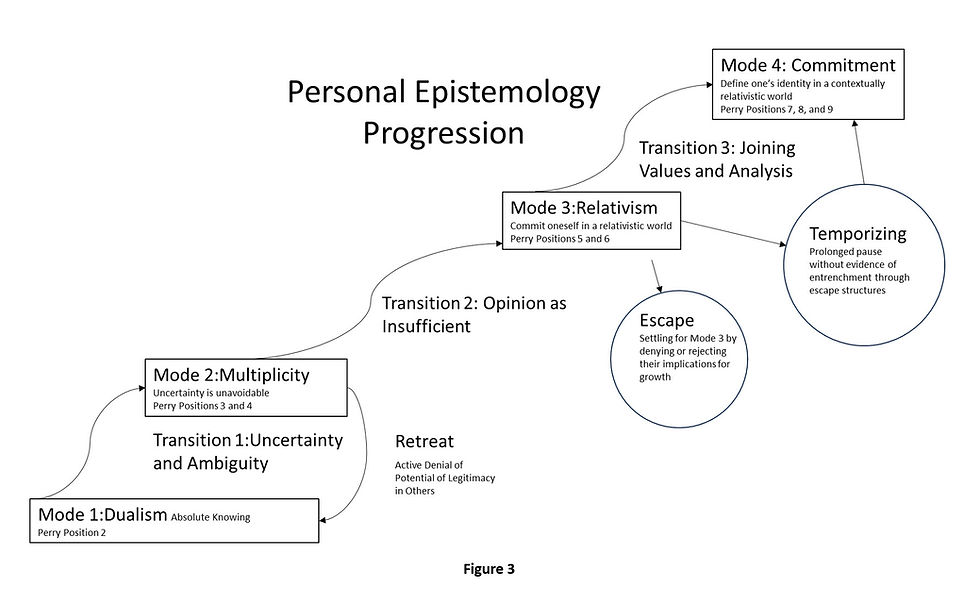


Moving to the Commitment, Reflective Thinking and Contextual Knowing mode or stage of the models, primary developmental emphasis shifts from intellectual to ethical: namely, the anticipation, clarification, and ongoing refinement of Commitments. These “Commitments”— distinguished from commitments or “considered choices” by being chosen in the face of legitimate alternatives, after experiencing genuine doubt, and reflecting a clear affirmation of oneself or identity—define one’s identity in a contextually relativistic world.
Epistemology and Education
A study by King and Kitchener measured progress through their Reflective Judgment Model (RJM) stages of Pre-Reflective, Quasi-Reflective and Reflective Thinking using a seven point scale of high school, college and graduate school graduates. The major question addressed in the study was whether students from three age/educational levels would reason at different stages on the reflective judgment model. A consistent upward progression of scores as a function of education was found over the three student groups.

A study of educators attending an educational leadership program surveyed King and Kitchener’s reflective judgment model (RJM). The population’s years of experience are shown in Figure 5 and the RJM stages are shown in Figure 6.


Combining the available data from the various studies that have been conducted over the past 30 years I estimate that only 10-15% of the students graduating from college has progressed to the multiplicity stage and no more than 5% of that population has achieved a contextual knowing and about 1% of that population has achieved Stage 7 Reflective Thinking capability.
Cognitive maturity requires viewing knowledge as contextual, or as constructed using relevant evidence in a particular context. A contextual view of knowledge recognizes that multiple perspectives exist, depending on how people structure knowledge claims. It further requires the capacity to participate in constructing, evaluating, and interpreting judgments considering available evidence and frames of reference. Contextual knowers construct knowledge claims internally, critically analyzing external perspectives rather than adopting them uncritically. Increasing maturity in knowledge construction yields an internal belief system that guides thinking and behavior that is also open to reconstruction given relevant evidence. Cognitive outcomes such as intellectual power, reflective judgment, mature decision making, and problem solving depend on these epistemological capacities.
Relationships – Interpersonal Foundation
How people view themselves in relation to others and how they construct relationships is the interpersonal dimension of self. Mature relationships are characterized by respect for both one’s own and others’ particular identities and cultures as well as by productive collaboration to negotiate and integrate multiple perspectives and needs. Interdependence requires openness to other perspectives without being consumed by them. Your identity makes this interdependence possible by prioritizing self-approval as a criterion with which to judge others’ perspectives. From this perspective, one has relationships rather than being had by relationships. From this vantage point, it is no longer threatening to see differences (e.g., cultural, political, and geographical) or to acknowledge that people hold multiple perspectives; this capacity enables the individual to become interculturally mature. Mutuality is possible because of the capacity to explore others’ perspectives as well as one’s own.
People may have to break free of dependent relations in which others are the source of identity and needed affirmation. Breaking free involves becoming aware of the limitations of dependent relationships; recognizing the need to bring owns identity into constructing independent relationships and struggling to extract self from dependent relationships. Self-authorship involves the capacity to engage in authentic, interdependent relationships with diverse others in which self is not overshadowed by need for others’ approval; mutually negotiating relational needs; genuinely taking others’ perspectives into account without being consumed by them.
The Transformation to Self-Authorship
An individual’s transformation to self-authorship is not instantaneous but occurs over time in sequential phases: (1) Following Formulas, (2) the Crossroads, and (3) Becoming the Author of One’s Life. In the initial phase, Following Formulas, adolescents rely on external opinions for their values and beliefs. Their identity or “self” is externally defined and easily influenced by others, often their peers. They adopt externally defined “formulas for success” to not only guide their actions but also define their successes. Students often enter college in this phase and have followed the advice of others (a formula for success) to get there. The development across the three dimensions is shown in Table 3.

Developing self-authoring capacities during higher education can provide young adults with the foundation for independent adult decision making, and effective interdependent relationships and citizenship. Such capacities would influence decisions concerning their communities, their political preferences, ethical behavior, climate-related actions and social responsibilities. Maturity in all three dimensions (cognitive, intrapersonal and interpersonal) can engender genuine ethical action). Magdola’s longitudinal participants relied on external authority during college, yet quickly began to question it soon after graduation when they encountered the demand for developing their internal voices.
The expected core outcomes of most Western higher education programs include effective citizenship, critical thinking, complex problem solving, interdependent relations with diverse others and mature decision making. Such overarching higher education outcomes require informational learning (that is, knowledge and skills) and transformational learning, where an individual behaves in accordance with their own values, feelings and meanings rather than those uncritically assimilated from others.
The success of teaching self-authorship is difficult to measure. Kegan and Lahey published the following graph in Handbook of Leadership Theory and Practice by Nitin Nohria and Rakesh Khurana.

The authors state both studies are skewed toward middle-class, college-educated professionals, the actual percentage in the general population of college graduates is likely even lower than the ~40% capable of self-authoring.
The Self as Problem Solver
We live in a world of well structured, ill-structured, wicked problems and super wicked problems.
· A 'well-structured problem' yields a right answer through the application of an appropriate algorithm. Most textbook problem in mathematics, science, engineering, or business feature well-structured problems that have right answers.
· Ill-structured problems are characterized by their lack of a clear path to a solution. They include unknown problem elements, multiple solutions, and multiple criteria for evaluating solutions that require learners to make judgments or take a stand on issues.
· A wicked problem is a problem that is difficult or impossible to solve because of incomplete, contradictory, and changing requirements that are often difficult to recognize. It refers to an idea or problem that cannot be fixed, where there is no single solution to the problem; and "wicked" denotes resistance to resolution, rather than evil.
· Super wicked problems comprise four key features: time is running out; those who cause the problem also seek to provide a solution; the central authority needed to address them is weak or non-existent; and irrational discounting occurs that pushes responses into the future.
As an individual, one can solve well-structured and ill-structured problems. One can participate in solving wicked and super-wicked problems, but these problems are beyond the capability of a single individual.
Solving a Well Structured Problem
These problems are well defined, with little context dependence and have one solution. They can be solved by either knowing the answer, looking up the answer or finding an authority that knows the answer. At least 90% of the US population has the ability to solve this kind of problem.
Solving Ill-Structured Problems
Sometimes called 'ill-defined' problems or a ‘messy’ problem, an ill-structured problem doesn't yield a particular or certain answer. Ill-structured problems mirror real world problems where data are conflicting or inclusive, where disputants disagree about appropriate assumptions or theories, or where values are in conflict. Disputants may propose different solutions to the problem, each with particular strengths and weaknesses. In approaching an ill-structured problem, the thinker must attend to alternative points of view and create arguments justifying the proposed solution. One responds to a well-structured problem with a right answer but to an ill-structured problem with the best available solution and a justifying argument.
Self-authoring and problem solving
The link between problem solving and self-authoring is best illustrated by the relating the epistemological foundation to problem solving shown in Table 4 recognizing that intrapersonal and interpersonal foundations also enter in the solving of ill-structured problems. Relating back to Table 1, probably no more than 5% of college graduates can effectively solve ill-structured problems.


Wicked and Super-Wicked Problems
These types of problems are beyond the scope of this article. Wicked problems require collaboration to arrive at a solution. Natural disaster response planning is a wicked problem for which solutions are in place. I know of no examples of solutions to super-wicked problems. We have been struggling with the problem of Climate Change for more than 20+ years with little success.
Trajectory of Societal Changes
Types of Trajectories
Worldviews not only provide a filter through which to see the present, they also provide the basis for how one sees trajectories of societal change.Bain (https://onlinelibrary.wiley.com/doi/full/10.1111/ajsp.12574) suggests there are five basic Trajectories of Societal Changes in time as shown in Figure 8.

Five trajectories are shown.
Progress, indicating improvement over time.
Golden Age, indicating decline from an idealized past.
Endless Cycle, indicating continual oscillation between alternate states without overall change.
Balance, indicating movement towards an optimal or satisfactory state while keeping oscillations within a moderate range.
Maintenance—indicating neither improvement nor decline, maintaining things in their current state without oscillations.
Bain presents empirical associations between these trajectories and social change issues and summarizes the results.
In US samples, Balance was most important for sustainability, Golden Age (and to some degree Progress) for innovation, and Golden Age for politics (at least for the 2016 US election). Examining associations with social change issues across countries/regions suggested that the associations identified in US samples are unlikely to be universal. For example, across countries there was a general association between Golden Age, Endless Cycle, and Maintenance change worldviews and support for pro-environmental and pro-social actions that were not identified in the US.
World Trajectories
To the surprise of many in the West, the fall of the USSR in 1991 did not lead to the adoption of liberal democratic government around the world and the much anticipated “end of history.” In fact, authoritarianism has made a comeback, and liberal democracy has been on the retreat for at least the last 15 years culminating in the unthinkable: the invasion of a democratic European country by an authoritarian regime. (https://journals.sagepub.com/doi/epub/10.1177/10564926221119395).
A world trajectory is published annually by Freedom House (https://freedomhouse.org/). Freedom House is a non-profit organization group in Washington, D.C. It is best known for political advocacy surrounding issues of democracy, political freedom, and human rights. It describes itself as a "clear voice for democracy and freedom around the world". When Freedom House issued the first edition of its global survey in 1973, 44 of 148 countries were rated Free. Today, 84 of 195 countries are Free. Over the past 50 years, consolidated democracies have not only emerged from deeply repressive environments but also proven to be remarkably resilient in the face of new challenges. The gap between the number of countries that registered overall improvements in political rights and civil liberties and those that registered overall declines for 2022 was the narrowest it has ever been through 17 years of global deterioration. Thirty-four countries made improvements, and the tally of countries with declines, at 35, was the smallest recorded since the negative pattern began (https://freedomhouse.org/report/freedom-world/2023/marking-50-years).
The World Values Survey (WVS) has conducted surveys of multiple countries since 1981 (https://www.worldvaluessurvey.org/WVSContents.jsp). The WVS produces the Inglehart–Welzel Cultural Map. The map presents empirical evidence of massive cultural change and the persistence of distinctive cultural traditions. Analysis of WVS data made by political scientists Ronald Inglehart and Christian Welzel asserts that there are two major dimensions of cross cultural variation in the world:
1) Traditional values versus Secular-rational values and
2) Survival values versus Self-expression values.
The Inglehart Welzel modernization theory postulates that modernization leads to enduring mass attitudinal changes that are conducive to democracy. A 2011 paper (https://nnov.hse.ru/data/2011/03/21/1211300861/ChangingMassPriorities.pdf ) reviews some of the evidence supporting that conclusion.
To date the WVS has issued 7 maps based on surveys of countries collected multi-year waves (typically 5 years) since 1981.The 2023 and 1996 maps are shown below.
Comparing the 2023 map with the 1996 map, a shift of the European countries towards higher self-expression values. Higher self-expression values show high priority is given to environmental protection, growing tolerance of foreigners, gays and lesbians and gender equality, and rising demands for participation in decision-making in economic and political life. Reviewing the maps, the United States self-expression values have changed little in the last twenty years after increasing for about 10 years, which is a significantly different pattern than observed western European democracies, Canada and Japan.
Looking at Figures 9 and 10 the United States has seen little rise in emancipative values and self-expression values in the last twenty years. Emancipative values combine an emphasis on freedom of choice and equality of opportunities. Emancipative values, thus, involve priorities for lifestyle liberty, gender equality, personal autonomy and the voice of the people. Self-expression values give high priority to environmental protection, growing tolerance of foreigners, gays and lesbians and gender equality, and rising demands for participation in decision-making in economic and political life.


United States Trajectory
Since 2012 the United States has been engaged in a cultural war. "There's almost a cold war in America over the future of the country, and central to that debate is the issue of race and ethnicity, not only Black people but all nonwhite peoples," according to Marc Morial, president and chief executive officer of the National Urban League.
Coalition of Transformation vs. Coalition of Restoration
The terms Coalition of Transformation and a Coalition of Restoration were coined by Ronald Brownstein after the 2012 Presidential election (https://www.theatlantic.com/politics/archive/2012/11/the-coalition-of-transformation-vs-the-coalition-of-restoration/265512/) to describe the divergence between the Democratic and Republican Parties.Democrat aligned themselves with transforming the country through support for such issues as gay marriage and legalizing undocumented immigrants.The Republicans aligned themselves with restoring the political dominance of married, churchgoing white families consistent with the Tea Party's 2010 cry to "take back our country."The subsequent 10 years have exacerbated the division such the two trajectories now compete to establish a direction for the country.The Coalition of Transformation aims to move the country in an upper right direction on the Inglehart Welzel Cultural Map while the Coalition of Restoration aims to move the country in a lower left direction on the Inglehart Welzel Cultural Map.
Political Typology
PEW Research developed a typology based on surveys of a large nationally representative panel, which incorporated surveys of validated 2020 voters. The political typology divides the public into nine groups. [Beyond Red vs. Blue: The Political Typology (https://www.pewresearch.org/politics/2021/11/09/beyond-red-vs-blue-the-political-typology-2/)] The nine typology groups are
Faith and Flag Conservatives are intensely conservative in all realms; they are far more likely than all other typology groups to say government policies should support religious values and that compromise in politics is just “selling out on what you believe in.”
Committed Conservatives also express conservative views across the board, but with a somewhat softer edge, particularly on issues of immigration and America’s place in the world.
Populist Right, who have less formal education than most other typology groups and are among the most likely to live in rural areas, are highly critical of both immigrants and major U.S. corporations.
Ambivalent Right, the youngest and least conservative GOP-aligned group, hold conservative views about the size of government, the economic system and issues of race and gender.
Stressed Sideliners are generally disconnected from politics and the two major parties, voting at lower rates than most other typology groups. Although Stressed Sideliners make up 15% of American adults, they were just 10% of 2020 voters due to their relatively low turnout rate. Stressed Sideliners are split evenly between those who identify with or lean toward the Republican Party (45%) and those who are Democrats or Democratic leaners (an identical 45%). One-in-ten say they don’t lean toward either party.
Outsider Left, the youngest typology group, voted overwhelmingly for Joe Biden a year ago and are very liberal in most of their views, but they are deeply frustrated with the political system – including the Democratic Party and its leaders.
Democratic Mainstays, the largest Democratic-oriented group, as well as the oldest on average, are unshakeable Democratic loyalists and have a moderate tilt on some issues.
Establishment Liberals, while just as liberal in many ways as Progressive Left, are far less persuaded of the need for sweeping change.
Progressive Left, the only majority White, non-Hispanic group of Democrats, have very liberal views on virtually every issue and support far-reaching changes to address racial injustice and expand the social safety net.
The makeup of each category by political party, race, voters and population is shown in Figure 12.

Perhaps no issue is more divisive than racial injustice in the U.S. Figure 13 shows racial injustice remains a dividing line in U.S. politics. Among the four Republican-oriented typology groups, no more than about a quarter say a lot more needs to be done to ensure equal rights for all Americans regardless of their racial or ethnic background; by comparison, no fewer than about three-quarters of any Democratic group say a lot more needs to be done to achieve this goal.

Merging of Typology and Coalitions
With the emergence of Trump, the two coalitions are fully aligned with the two political parties. The Coalition of Restoration is composed of the Faith and Flag Conservatives, Committed Conservatives, Populist Right and the Ambivalent Right. The Coalition of Transformation is composed of the Outsider Left, Democratic Mainstays, Establishment Liberals, and Progressive Left.
Whites-Non-Hispanic make up ~80% of the Restorative Coalition and about 55% of the Transformative Coalition.Blacks make up about 20% of the Transformative Coalition but only 2% of the Restorative Coalition.Hispanic members of the Transformative Coalition outnumber Hispanic members of the Restorative Coalition 8 to 5.Members of the Transformative Coalition are younger and are better educated than members of the Restorative Coalition. Members of the Transformative Coalition outnumber members of the Restorative Coalition 2:1 in urban areas with the inverse occurring in rural areas. See Figures 14,15, and 16 and Table 5.


The two coalitions hold diametrically opposed positions on many of today’s issues that are along political party lines, see Figure 17.

Figure 18 shows the Life Views of conservatives strongly align with the Republican makeup of the categories except for the Ambivalent Right. The Life Views of Democrats are generally liberal, but the Moderate Life View is prevalent in the Democratic Mainstays and Establishment Liberal categories and only in the Progressive Left category does the Liberal Life View dominate.

Primal World Beliefs
In psychology, primal world beliefs (also known as primals) are basic beliefs humans hold about the general character of the world (https://psycnet.apa.org/doiLanding?doi=10.1037%2Fpas0000639). A study published a year ago (https://journals.sagepub.com/doi/abs/10.1177/19485506221119324) examined the primal beliefs of conservatives and liberals.
The following table of Primal World Views for the two coalitions was obtained from the supplemental material of the referenced paper.

Several of the Restorative Coalition’s Primal World Beliefs align with the conservative belief that a belief in God is necessary to be good or moral, shown in Figure 19.

United States Population Racial Makeup
Sometime after 2040, people of color will constitute a majority of the United States population, regardless of immigration and citizenship requirements.

This projection was made before the 2020 census. Correcting for 2020 census data and adding the years 1950 to 2010 this transition will likely occur before 2040.

Combining data on the share of total vote by race with the projected population by race Figure 22 is constructed

Combining this chart with the racial composition of the coalitions, a graph of the projected percent of

total United Sates vote going to each coalition is shown in Figure 23.In 2020 the Transformative Coalition accounted for about 45% of the vote while the Restorative Coalition accounts for about 42%.Because the US national vote system effectively allocates greater value to votes cast in the rural regions of the country which vote in the Restorative Coalition, the US is currently in a stalemate with neither coalition able to gain an advantage. Ultimately the Transformative Coalition must exceed the Restorative Coalition vote by about 5% to enable it to pass legislation to transform the county.

It is estimated that this would occur between 2030 and 2035. Until sometime after 2035, when the Transformative Coalition has a clear advantage, the collations will continue to battle back and forth.
Conclusion
Worldwide the trajectory of societal change is Balance as individual countries oscillate between overall improvements in political rights and civil liberties and authoritarianism. The United States remains in a Trajectory of Maintenance which began in approximately 2000. An argument can be made that the country is on the Golden Age trajectory considering Al Gore’s concession of the 2000 presidential election when he decided not to appeal the Supreme Court decision and “for the sake of our unity of the people and the strength of our democracy” compared to Donald Trump’s attempt to overturn the 2020 election results and his continued claim that the 2020 election was stolen from him.
Most (90%) of United States voters have aligned themselves into two irreconcilable coalitions. The Transformative Coalition is trying to build something without exact modern precedent: a true multi-racial democracy that provides a voice to all its citizens. The Restorative Coalition is trying to return to a democracy controlled by the white race and their supporters. The two coalitions are geographically split between Rural and Urban areas of the country. The Transformative Coalition, being younger and better educated look to form a democracy for all citizens while the Restorative Coalition, being older and less well educated looks to retain a democracy that allows them to retain power even as their relative share of the vote decreases. The primal values of the two coalitions are significantly different making it difficult to envision the two sharing power.

Comments