
6 Examination of Global Warming: Impacts and Risks
6 Impacts and Risks of Global Warming
6.1 United States
The following are from the Fourth National Climate Assessment (https://nca2018.globalchange.gov/downloads/NCA4_Report-in-Brief.pdf)
Temperature Change


Sea Level

Water Infrastructure
Deteriorating water infrastructure compounds the climate risk faced by society. Extreme precipitation events are projected to increase in a warming climate and may lead to more severe floods and greater risk of infrastructure failure in some regions. Infrastructure design, operation, financing principles, and regulatory standards typically do not account for a changing climate. Current risk management does not typically consider the impact of compound extremes (co-occurrence of multiple events) and the risk of cascading infrastructure failure.
Forests
It is very likely that climate change will decrease the ability of many forest ecosystems to provide important ecosystem services to society. Tree growth and carbon storage are expected to decrease in most locations as a result of higher temperatures, more frequent drought, and increased disturbances.
Coastal Effects
America’s trillion-dollar coastal property market and public infrastructure are threatened by the ongoing increase in the frequency, depth, and extent of tidal flooding due to sea level rise, with cascading impacts to the larger economy. Higher storm surges due to sea level rise and the increased probability of heavy precipitation events exacerbate the risk. Under a higher scenario (RCP8.5), many coastal communities will be transformed by the latter part of this century, and even under lower scenarios (RCP4.5 or RCP2.6), many individuals and communities will suffer financial impacts as chronic high tide flooding leads to higher costs and lower property values.
Agriculture and Rural Communities
Food and forage production will decline in regions experiencing increased frequency and duration of drought. Shifting precipitation patterns, when associated with high temperatures, will intensify wildfires that reduce forage on rangelands, accelerate the depletion of water supplies for irrigation, and expand the distribution and incidence of pests and diseases for crops and livestock. The degradation of critical soil and water resources will expand as extreme precipitation events increase across our agricultural landscape. Sustainable crop production is threatened by excessive runoff, leaching, and flooding, which results in soil erosion, degraded water quality in lakes and streams, and damage to rural community infrastructure.
Challenges to human and livestock health are growing due to the increased frequency and intensity of high temperature extremes. Extreme heat conditions contribute to heat exhaustion, heatstroke, and heart attacks in humans. Heat stress in livestock results in large economic losses for producers.
6.2 Economic Consequences of Climate Change
6.2.1 US Impact
The conclusions of the IPCC (https://www.ipcc.ch/site/assets/uploads/sites/2/2019/02/SR15_Chapter3_Low_Res.pdf), quoted a paper by Yohe (https://link.springer.com/article/10.1007%2Fs10584-017-2100-3) that found a U.S. GDP loss of 1.2% per degree of warming

The recently released Fourth National Climate Assessment predicts the U.S. economy will shrink by as much as 10% by the end of the century if the business-as-usual scenario (RCP8.5) occurs (https://www.sciencenews.org/article/climate-change-economic-cost-united-states). The following shows some of these losses

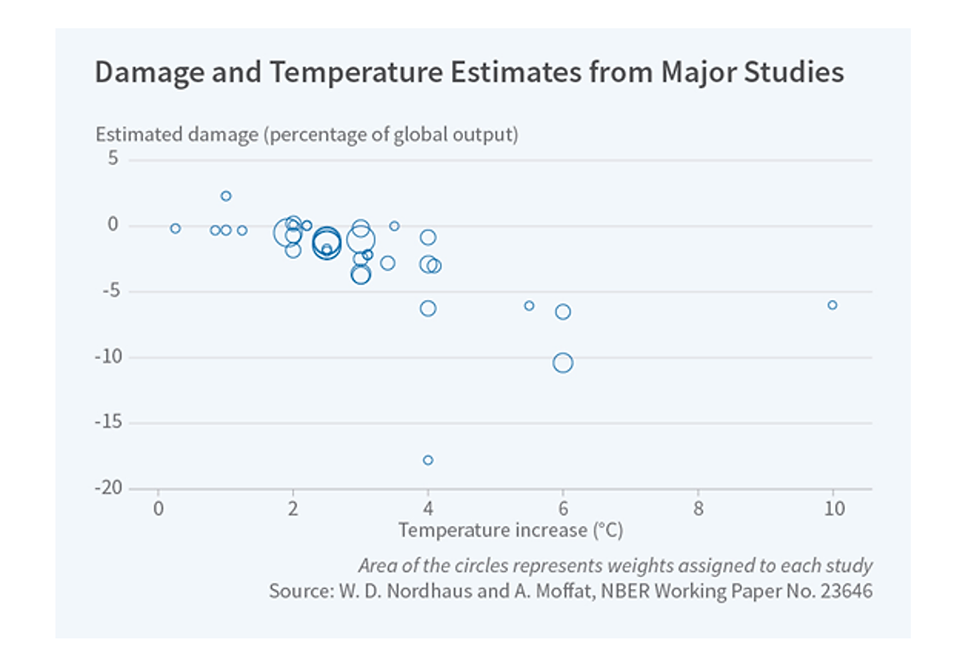
If the modest action scenario occurs the damage to the U.S. economy in 2100 would be about a 1% loss (https://wattsupwiththat.com/2019/08/12/is-global-warming-an-existential-threat-probably-not-but-still-a-serious-issue/). W. D. Nordhaus examined a large number of studies regarding the impacts of global warming on the world’s economy (see below). He and his co-author (A Moffat) found that a 2C increase in global temperatures would result in 0-1% damage to the world economy in 2100. Doubling the warming would only increase the damage to around 3% (https://www.nber.org/papers/w23646).
6.3 World Impact
Worldwide estimates have been provided by Diaz and Moore (https://par.nsf.gov/servlets/purl/10075906) using three integrated assessment models shows a similar result.

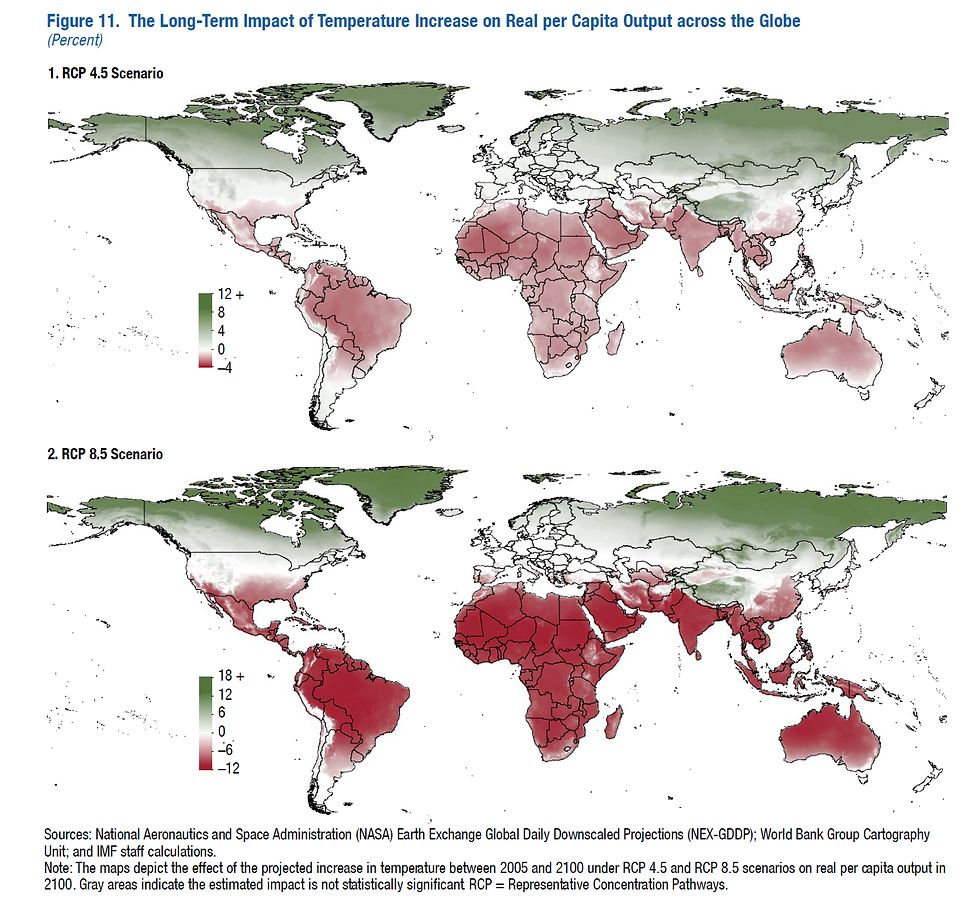
An IMF (International Monetary Fund) working paper discussed the prospect that increases in temperature have uneven macroeconomic effects, with adverse consequences concentrated in countries with hot climates, such as most low-income countries. In these countries, a rise in temperature lowers per capita output, in both the short and medium term, through a wide array of channels: reduced agricultural output, suppressed productivity of workers exposed to heat, slower investment, and poorer health. In an unmitigated climate change scenario, and under very conservative assumptions, model simulations suggest the projected rise in temperature would imply a loss of around 9 percent of output for a representative low-income country by 2100 (https://www.imf.org/en/Publications/WP/Issues/2018/06/22/The-Effects-of-Weather-Shocks-on-Economic-Activity-What-are-the-Channels-of-Impact-45970). The global distribution of effects for the RCP 4.5 and 8.5 scenarios is illustrated by
Despite the Paris Agreement’s focus on the 1.5°C and 2°C targets, its actual Nationally Determined Contributions (NDCs) are instead consistent with 2.5–3°C of global warming. This level of warming could lead to a reduction in global GDP as high as 10% by mid-century and 15%–25% by the end of the century (median estimates across SSPs; Fig. 4), relative to a world that did not warm beyond 2000–2010 levels. In addition, failing to meet the NDC commitments is likely to lead to reductions in global GDP that exceed 25% by the end of the century. Uncertainty in these estimates is driven much more by uncertainty in economic parameters—namely, the economic response to warming and the discount rate—than by uncertainty in the pattern and magnitude of temperature change reflected in the climate model ensemble (Fig. 4b and c), highlighting the importance of better constraining these economic parameters. (https://web.stanford.edu/~mburke/papers/BurkeDavisDiffenbaugh2018.pdf)


Comments